

Not all dog trainers are equal. Use this checklist of must-ask questions to find a qualified, science-based trainer for your dog.
Disclosure
This guide was written by Dr. Pepe Hernandez, founder of PJH Dog Training. PJH Dog Training is cited once below as an example of a trainer publishing its certification details. The checklist itself is not specific to any one trainer.
Dog training has no bouncer at the door. In most of the United States, there is no government-issued professional license required simply to call oneself a dog trainer. That means consumers can encounter wide variation in education, oversight, and methods. That's the trap most pet parents fall into: pick based on a nice website, a low price, or a friend's recommendation, then three sessions in, realize the approach doesn't fit their dog at all.
This checklist fixes that. Here's exactly what to ask, what to watch for, and which red flags mean you keep walking.
Why Choosing the Right Dog Trainer Matters
Your trainer shapes more than a sit-stay. Training methods can influence dogs' stress, welfare, behavior, and interactions with their owners, with evidence that some effects of aversive training can extend beyond the training session itself.[1–3] The American Veterinary Society of Animal Behavior (AVSAB) has issued formal guidance on this issue. Aversive training is associated with poorer welfare indicators.[1–3,5] Reward-based approaches are favored in current veterinary-behavior guidance because they can teach effective behavior change while minimizing avoidable welfare risks.[1]
In most of the United States, dog trainers are not subject to a uniform government licensing standard. You're often the most important quality-control step. The upside: a handful of sharp questions tells you a great deal before you spend a dollar.
Step 1: Understand Their Training Philosophy and Methods
This is the one that matters most. How a trainer handles the moment your dog gets something wrong tells you what the whole relationship will feel like — and dogs get things wrong constantly, especially at the start.
Questions to Ask About Training Methods
- What training methods and tools do you use, and why?
- How do you respond when a dog doesn't perform a behavior correctly?
- Do you use positive reinforcement — and can you show me what that looks like in an actual session?
- What equipment do you use or recommend: collar type, leash, treats, clicker?
Reward-based, force-free — that's the answer you want to hear. A reward-based trainer focuses on reinforcing desired behavior and arranging the environment so the dog can succeed, rather than relying on fear, pain, or intimidation. This approach is grounded in established learning theory and is recommended by major veterinary-behavior guidance.[1,3,5]

Red Flags: Dominance-Based and Aversive Techniques
"Alpha." "Dominance." "Showing the dog who's boss." Dominance is a legitimate ethological concept describing relationships between animals, but using dominance or pack-rank theory as a general explanation for unwanted dog behavior — and using confrontation to establish human "alpha" status — is inconsistent with modern behavioral guidance.[6] The same concern applies when trainers routinely rely on prong collars, choke chains, electronic shock collars, or other techniques that use pain, fear, or intimidation.[1,4] A qualified trainer should be able to explain clearly what happens when a dog gets something wrong and why a particular method is being used.
Step 2: Verify Certifications and Education
No licensing means certification is the closest thing to an independent check this industry has.
Certifications Worth Looking For
A few credentials actually carry weight:
- CPDT-KA / CPDT-KSA / CBCC-KA — issued by the Certification Council for Professional Dog Trainers (CCPDT), an independent nonprofit that tests trainers on humane, science-based methods
- CDBC — Certified Dog Behavior Consultant, through the International Association of Animal Behavior Consultants
- KPA-CTP — Karen Pryor Academy Certified Training Partner
Ask what the certification actually required. Some mean real exams and continuing education; others mean showing up and paying a fee. A trainer holding CPDT-KA, for instance, will usually list it clearly and explain what the exam covers — the way PJH Dog Training does on its certification page. That kind of transparency tells you something.
Why Formal Education Matters
Certification isn't everything. Plenty of skilled trainers built their expertise the old way — years of hands-on apprenticeship, no letters after their name. But ongoing education tells you a trainer keeps up as the science moves. Ask how. And don't feel awkward asking to see proof of whatever they claim.
Step 3: Ask About Experience With Your Dog's Specific Needs
Great with basic obedience doesn't mean great with leash reactivity, resource guarding, or separation anxiety — those are different skill sets entirely. Ask directly:
- Have you worked with dogs with my dog's specific issue — breed, age, behavior challenge?
- Can you walk me through how you'd approach my dog's situation specifically?
- What's a realistic timeline and outcome, based on what you know so far?
Be skeptical of guarantees. Too many variables sit outside a trainer's control for anyone to promise a fixed result — a guarantee is usually a sales pitch dressed up as confidence.
Step 4: Observe a Class or Session Before You Commit
When practical, ask whether you can observe a public group class, demonstration, or another appropriate example of the trainer's work before committing. Observation can be a useful transparency signal, but a trainer may reasonably restrict access to private sessions because of client confidentiality, safety, or the needs of fearful or reactive dogs.[7]
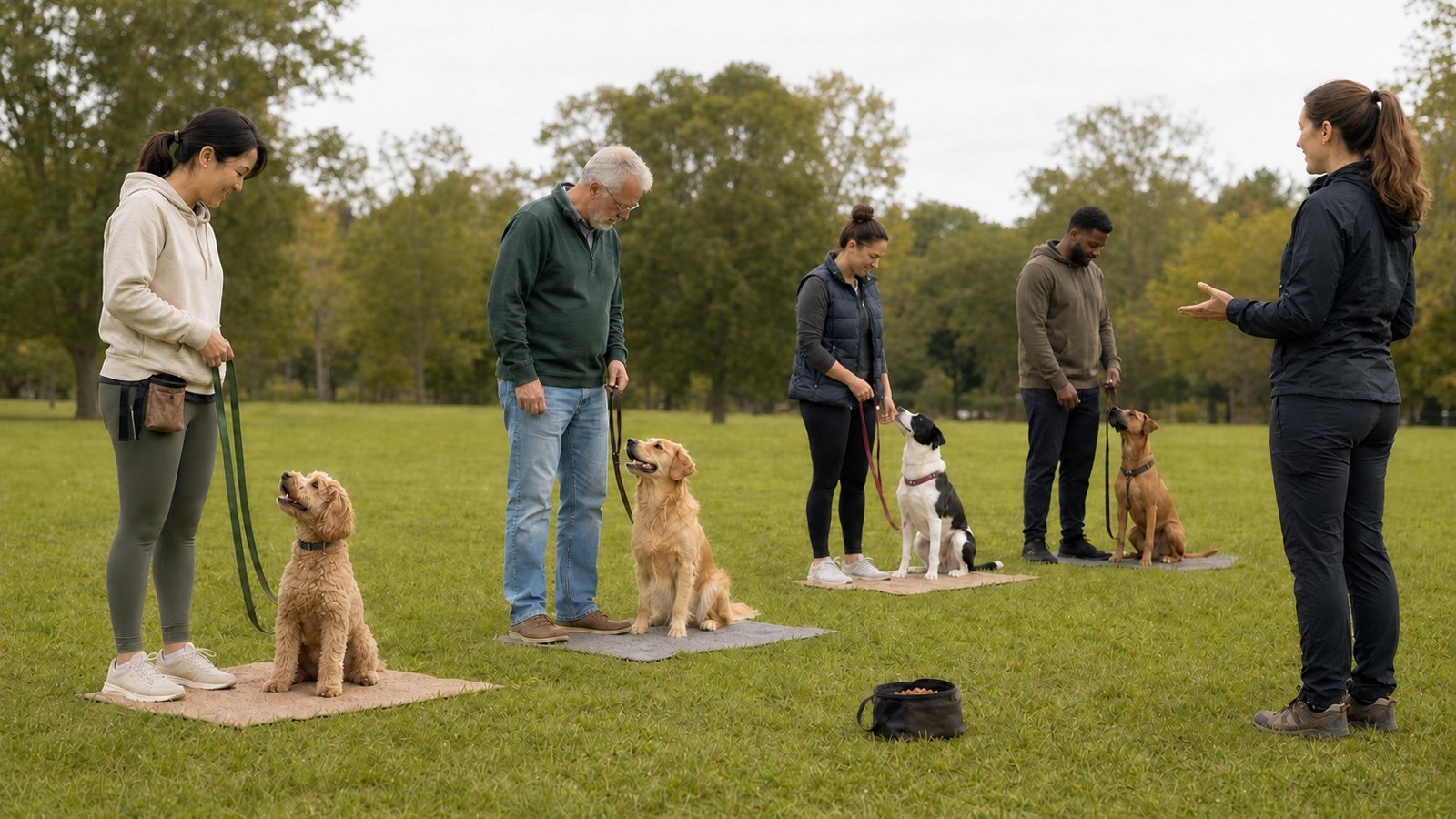
While you're there, watch for:
- Dogs that look relaxed and engaged, not shut down or fearful
- A trainer who stays patient with both dogs and their humans
- Calm, clear communication — not raised voices, not physical corrections
- An environment that feels safe and reasonably well-run
If direct observation isn't appropriate, ask for another meaningful way to evaluate the trainer's methods — such as videos, a public class, a detailed explanation of procedures, or recent references. A refusal to explain methods or provide any reasonable transparency is more concerning than a privacy-based limit on observing a specific session.
Step 5: Check References, Reviews, and Testimonials
Get two or three references you can actually call — not the quotes hand-picked for the homepage. Ask past clients directly:
- Did the training methods match what was promised upfront?
- How did the trainer handle setbacks or slow progress?
- Would you hire them again?
Check independent review platforms too, not just testimonials the trainer chose to publish. Furvisor's pet training listings show star ratings and reviews from owners the business didn't cherry-pick — a straighter read before you even make contact.
Step 6: Clarify Pricing, Guarantees, and Follow-Up Support
Before you sign anything, nail down:
- What's actually included in the price — sessions, follow-up check-ins, written homework?
- What happens if you need extra sessions beyond the original package?
- Is there a cancellation or refund policy?
- What support is available between sessions if you get stuck?
For many owners, access to follow-up support can make it easier to troubleshoot problems, maintain consistency, and adjust the training plan between sessions. Ask what support is included so you know what happens when real-life training gets messy.
The Complete Checklist: Questions to Ask Before Hiring a Dog Trainer
Bring this list to your first conversation with any trainer you're considering:
- What training methods and tools do you use, and why?
- How do you respond when a dog gets something wrong?
- What certifications do you hold, and how did you earn them?
- How do you keep your training education current?
- Have you worked with dogs with my dog's specific behavior challenge?
- Can I observe a public class or otherwise see an appropriate example of your training before enrolling?
- Can you give me references from recent clients?
- What's included in your pricing, and what happens if I need more sessions?
- What follow-up support do you offer once sessions end?
- What would you do if my dog isn't responding to the current approach?

Red Flags That Should Make You Walk Away
- Talk of "dominance," "pack leadership," or "alpha" status
- Reluctance to explain methods clearly or provide any reasonable way to evaluate how training is conducted
- Heavy reliance on prong, choke, or shock collars as standard practice
- Guaranteed results or fixed timelines regardless of the dog
- No verifiable certifications, references, or reviews
- Pressure to sign a contract or pay in full before you've even met the trainer
The BC SPCA publishes similar consumer guidance favoring force-free, reward-based training, ongoing education, transparency, and avoidance of fear- or pain-based techniques.[7] This is professional consumer guidance rather than a controlled study of trainer quality, but it broadly aligns with veterinary-behavior recommendations on humane training methods.[1]
Final Thoughts: Trust the Process — and Your Gut
A good trainer welcomes reasonable questions. They explain their methods without unnecessary jargon, treat both you and your dog with patience, and adjust the plan when the dog is struggling. Vetting a trainer takes a little extra time upfront, but it can help you avoid methods associated with unnecessary stress or poorer welfare and choose an approach that supports effective learning and a positive dog–human relationship.[1–3]
Starting your search? Check reviews from other owners in your area first. Furvisor's training directory makes side-by-side comparison easy before you ever book a consultation.
References Cited
[1] American Veterinary Society of Animal Behavior (AVSAB). Position Statement on Humane Dog Training. 2021 (current statement reaffirmed by AVSAB in 2025). https://avsab.org/resources/position-statements/
[2] Vieira de Castro AC, Fuchs D, Morello GM, Pastur S, de Sousa L, Olsson IAS. Does training method matter? Evidence for the negative impact of aversive-based methods on companion dog welfare. PLOS ONE. 2020;15(12):e0225023. doi:10.1371/journal.pone.0225023.
[3] Ziv G. The effects of using aversive training methods in dogs—A review. Journal of Veterinary Behavior. 2017;19:50–60. doi:10.1016/j.jveb.2017.02.004.
[4] Cooper JJ, Cracknell N, Hardiman J, Wright H, Mills D. The welfare consequences and efficacy of training pet dogs with remote electronic training collars in comparison to reward based training. PLOS ONE. 2014;9(9):e102722. doi:10.1371/journal.pone.0102722.
[5] Hiby EF, Rooney NJ, Bradshaw JWS. Dog training methods: their use, effectiveness and interaction with behaviour and welfare. Animal Welfare. 2004;13:63–69. doi:10.1017/S0962728600026683.
[6] American Veterinary Society of Animal Behavior (AVSAB). Position Statement on the Use of Dominance Theory in Behavior Modification of Animals. https://avsab.org/resources/position-statements/
[7] BC SPCA. How to choose a dog trainer. https://spca.bc.ca/how-to-choose-a-dog-trainer/

